Unplanned equipment failure is one of the biggest operational risks in industrial environments. A single machine breakdown can stop an entire production line, delay shipments, increase maintenance costs, and even create safety hazards for employees.
In industries such as manufacturing, oil & gas, utilities, and energy, the cost of downtime can reach thousands of dollars per hour. But the real problem isn’t just the breakdown itself—it’s the chain reaction it creates across production, logistics, and maintenance operations.
The good news is that most equipment failures are predictable and preventable. Machines rarely fail without warning. By understanding the most common causes of equipment failure and implementing preventive maintenance strategies, organizations can significantly reduce downtime and extend asset life.
What Is Equipment Failure?
Equipment failure occurs when a machine cannot perform its intended function, resulting in operational disruptions, reduced efficiency, or safety risks.
Failures generally fall into two main categories:
Type of Failure | Description | Example |
Sudden Failure | Happens unexpectedly without obvious warning signs | Motor burnout |
Gradual Failure | Performance degrades over time before failure occurs | Bearing wear |
Gradual failures are far more common in industrial equipment and often provide early warning signals that allow maintenance teams to intervene before a complete breakdown occurs. Understanding these signals is critical for effective maintenance planning.
Early Warning Signs of Equipment Failure
Machines almost always show symptoms before they fail completely. Identifying these warning signs early can prevent catastrophic equipment damage.
Common Failure Indicators
Warning Sign | Possible Cause |
Excessive vibration | Misalignment or imbalance |
Overheating | Poor lubrication or friction |
Strange noises | Worn bearings or loose components |
Increased energy consumption | Mechanical inefficiency |
Frequent small breakdowns | Underlying maintenance issues |
Ignoring these symptoms often leads to larger and more expensive failures later. Maintenance teams that monitor these signals regularly can take corrective action before operations are disrupted.
The Real Cost of Equipment Failure
Equipment failure is not just a maintenance issue, it is a critical business risk that can disrupt entire operations. While the immediate focus is often on repair costs, the true impact of equipment failure extends far beyond fixing a broken component.
Unplanned breakdowns can halt production lines, delay deliveries, strain maintenance teams, and create safety hazards for workers.
Operational Impact of Equipment Failures
Impact Area | Consequence |
Production | Unplanned downtime halts operations |
Financial | Emergency repairs increase maintenance costs |
Safety | Malfunctioning equipment can cause accidents |
Asset Life | Repeated breakdowns shorten equipment lifespan |
Productivity | Maintenance teams shift from proactive to reactive work |
Organizations that rely solely on reactive maintenance often experience higher operational costs and more frequent disruptions.
The 5 Most Common Causes of Equipment Failure
Equipment failures usually stem from a small number of recurring problems. Understanding these causes helps organizations design better maintenance strategies.
1. Lack of Preventive Maintenance
One of the most common reasons equipment fails is the absence of a structured preventive maintenance program.
In many facilities, maintenance teams are constantly responding to emergencies. When machines are repaired only after they break down, small problems accumulate over time until they lead to catastrophic failures.
For example:
- loose bolts remain unchecked
- lubrication is skipped
- worn parts are not replaced
Eventually these minor issues cause major damage.
Consequences of Poor Preventive Maintenance

How to Prevent It
Organizations should implement a preventive maintenance schedule that includes:
- routine inspections
- lubrication intervals
- part replacement cycles
- maintenance documentation
A Computerized Maintenance Management System (CMMS) can automate these tasks and ensure that no maintenance activity is missed.
2. Improper Equipment Operation
Equipment is designed to operate within specific parameters. When machines are operated incorrectly, they experience excessive stress and accelerated wear.
Improper operation can occur due to:
- lack of operator training
- overloading machinery
- ignoring operating procedures
- running equipment continuously without rest
Examples of Operational Mistakes

Over time, these practices lead to premature equipment failure.
How to Prevent It
Organizations can reduce operator-related failures by:
- implementing operator training programs
- documenting standard operating procedures
- monitoring equipment usage patterns
Maintenance logs and equipment manuals stored in a CMMS also help ensure that operators follow correct procedures.
3. Poor Lubrication and Contamination
Lubrication is critical for reducing friction between moving components. When lubrication is inadequate or contaminated, equipment experiences increased wear and overheating.
Common lubrication problems include:
- incorrect lubricant type
- insufficient lubrication
- over-lubrication
- contamination from dirt or moisture
Lubrication Failures
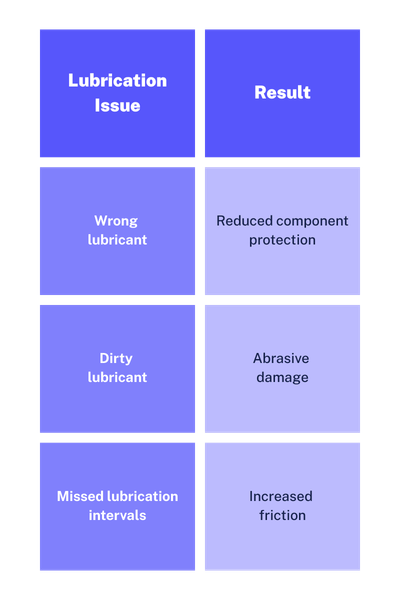
Rotating equipment such as bearings, gears, and motors are particularly vulnerable to lubrication problems.
How to Prevent It
Maintenance teams should implement lubrication management programs, which include:
- defined lubrication schedules
- proper lubricant selection
- contamination monitoring
Maintenance software can automatically remind technicians when lubrication tasks are due.
4. Equipment Wear and Aging
Even with proper maintenance, all machinery eventually experiences natural wear and aging.
Continuous operation gradually degrades components due to:
- mechanical friction
- thermal stress
- fatigue from repeated cycles
- environmental exposure
Components Most Affected by Wear

Without monitoring equipment condition, worn parts may fail suddenly.
How to Prevent It
Effective strategies for managing equipment aging include:
- condition monitoring
- scheduled component replacement
- tracking equipment performance history
A CMMS helps maintenance teams maintain detailed asset lifecycle records, allowing them to predict when parts need replacement.
5. Poor Maintenance Planning and Spare Parts Management
Even when maintenance teams identify potential problems, poor planning can delay repairs and increase downtime.
Common planning challenges include:
- missing spare parts
- untracked work orders
- poorly scheduled maintenance tasks
- lack of maintenance visibility
Maintenance Planning Problems

These issues lead to longer repair times and increased operational disruption.
How to Prevent It
Improving maintenance planning requires better coordination and information management.
Key solutions include:
- centralized work order management
- spare parts inventory tracking
- maintenance scheduling systems
Maintenance management software helps teams organize tasks and ensure the right resources are available when needed.
How Preventive Maintenance Reduces Equipment Failures
Preventive maintenance focuses on maintaining equipment before breakdowns occur. Instead of waiting for a machine to stop working, maintenance teams follow scheduled activities such as inspections, lubrication, calibration, and component replacements to ensure equipment continues to operate efficiently.
This approach helps identify early signs of wear, misalignment, or performance degradation, allowing issues to be resolved before they escalate into costly failures.
Maintenance strategies typically fall into three categories:
Maintenance Strategy | Description | Example |
Reactive Maintenance | Repairs occur after failure | Emergency motor repair |
Preventive Maintenance | Scheduled maintenance based on time or usage | Monthly inspections |
Predictive Maintenance | Uses monitoring data to predict failures | Vibration monitoring |
Among these strategies, preventive maintenance provides a practical and cost-effective way to reduce equipment failures.
How CMMS Software Helps Prevent Equipment Failure
Modern maintenance teams use Computerized Maintenance Management Systems (CMMS) to manage maintenance operations and improve asset reliability. As industrial environments become more complex, relying on manual processes makes it difficult to track maintenance activities, monitor equipment performance, and respond to issues quickly.
A CMMS provides a centralized platform where maintenance teams can plan, execute, and monitor all maintenance tasks efficiently. By organizing asset information, maintenance schedules, and work orders in one place, it enables better coordination across teams and ensures that critical maintenance activities are not overlooked.
Key CMMS Capabilities
CMMS Feature | Benefit |
Preventive maintenance scheduling | Ensures regular maintenance |
Work order management | Organizes repair activities |
Asset history tracking | Identifies recurring failures |
Spare parts inventory | Prevents maintenance delays |
Maintenance analytics | Improves maintenance planning |
By providing better visibility into maintenance operations, CMMS systems help organizations move from reactive maintenance to proactive asset management.
Best Practices for Preventing Equipment Failure
Preventing equipment failure requires more than just fixing machines when they break—it demands a proactive maintenance approach. Organizations that consistently achieve high asset reliability focus on building strong maintenance practices that combine people, processes, and technology. Organizations can reduce equipment failures by following these best practices:
Best Practice | Benefit |
Implement preventive maintenance | Detect problems early |
Train operators regularly | Reduce misuse |
Monitor equipment condition | Identify warning signs |
Track asset performance | Improve maintenance decisions |
Use CMMS software | Streamline maintenance operations |
These strategies help maintenance teams maintain equipment reliability and reduce operational disruptions.
Conclusion
Equipment failure is one of the costliest challenges faced by industrial organizations. However, most failures result from predictable issues such as poor maintenance practices, improper operation, lubrication problems, equipment aging, and ineffective maintenance planning.
By identifying these root causes and implementing proactive maintenance strategies, organizations can significantly reduce downtime, extend asset life, and improve operational efficiency.
Maintenance teams that leverage digital tools such as CMMS software gain greater visibility into equipment performance and maintenance activities. This enables them to detect early warning signs, schedule preventive maintenance, and address potential issues before they escalate into major failures.
Ultimately, preventing equipment failure is not just about repairing machines—it is about creating a data-driven maintenance strategy that keeps operations running reliably and efficiently.